


 |
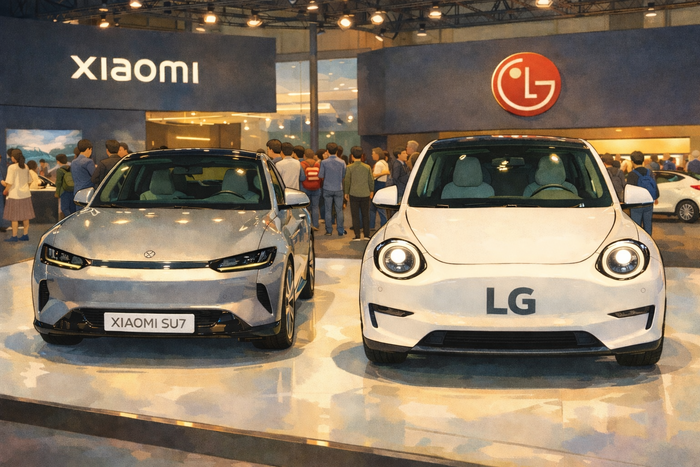
| AI가 만든 가상 이미지 |
“샤오미가 테슬라를 제쳤다.” 지난달 중국 시장에서 이변이 일어났다. 가전·스마트폰 회사 샤오미가 만든 전기차 YU7이 중국 월간 판매 1위에 올랐다. 테슬라 모델Y 판매량의 두 배를 넘겼다. 샤오미의 핵심 경쟁력은 ‘가성비’와 ‘통합형 하드웨어 설계’다. 전기차를 또 하나의 전자제품으로 본 관점의 전환, 거기서 혁신이 시작됐다.
그 역발상을 보며 문득 LG를 떠올렸다. LG는 오랫동안 도전을 ‘할 수 있었는데 하지 않은’ 기업의 대명사처럼 인식돼 왔다. 1997년 외환위기 당시 반도체 사업을 포기한 결정은 지금도 두고두고 회자된다. 그 결과 2000년대 초 이후 시가총액 기준으로 보면 SK하이닉스 400배, 삼성전자가 20배 성장한 데 비해 LG전자는 3배에 그쳤다.
물론 현재 전기차 시장은 더 이상 ‘보급 초기’가 아니다. 중국에선 수백개 전기차 스타트업이 사라졌고, 2030년까지 살아남을 브랜드는 손에 꼽힐 것이란 전망이다. 이런 환경에서 “LG도 전기차를 만들라”고 쉽게 말하는 건 무책임할 수 있다.
그럼에도 흥미로운 질문은 남는다. LG는 정말 못 하는가. 지금 LG를 다시 들여다보면 묘한 생각이 든다. 이 기업이 어느새 전기차를 ‘거의 다 갖춘’ 회사가 됐다는 사실 때문이다. 배터리는 LG에너지솔루션, 차량용 센싱과 카메라는 LG이노텍, 디스플레이는 LG디스플레이, 전장 소프트웨어와 인포테인먼트는 LG전자 VS사업본부, 구동 모터는 LG마그나, 조명은 LG가 인수한 ZKW가 맡고 있다. 글로벌 완성차에 들어가는 핵심 부품 상당수가 이미 ‘LG산’이라는 얘기다.
전기차 시대의 본질은 하드웨어가 아니라 SDV(소프트웨어 정의 차량)다. 차량의 가치 중심축이 인포테인먼트, 자율주행, 인캐빈 경험으로 이동하고 있다. 이는 가전·디스플레이·통신·AI를 결합해 온 LG의 DNA와 맞닿아 있다. 물론 LG는 직접 완성차 시장에 뛰어들지 않았다. OEM(주문자 상표 부착 생산) 시장의 극단적인 경쟁 강도와 투자 리스크를 감안해 ‘B2B 기술 공급자’ 포지션을 택했다.
산업 전환기에는 결단의 타이밍이 중요하다. 한때 TV 1위에 안주하다 헬스케어 확장을 놓쳤다는 반성은 삼성전자 내부에서도 나온다. LG도 여기서 멈춰 서면 아쉽다. 중요한 건 실제로 전기차를 만들 것인지가 아니다. 리더가 발상의 전환을 선언할 수 있느냐다. ‘냉장고 만들 듯 전기차를’ 등의 도발적 상상은 실제 사업 여부와 무관하게, LG 내부에 잠든 엔지니어적 자신감을 깨우는 촉매가 될 수 있다.
예컨대 △전장·배터리·디스플레이를 묶은 ‘모빌리티 원팀’을 전면에 내세우거나 △AI·로봇·HVAC(냉난방공조)를 결합한 모빌리티 플랫폼을 제시하거나 △완성차와의 합작 형태로 브랜드 실험에 나서는 식의 과감한 제안은 충분히 가능하다. 그룹 자산 200조의 LG는 이미 전열을 갖췄다. 자산의 가치는 미래 설계 능력에 따라 달라진다. 2026년은 어쩌면 LG의 골든타임이다. 샤오미가 하는데, LG가 못할 이유는 없다.
심화영 기자 dorothy@
If Xiaomi Can Do It, Why Can’t LG?
By Sim Hwa-young
“Xiaomi has overtaken Tesla.”
A headline few expected appeared last month in China. Xiaomi, best known for its home appliances and smartphones, saw its electric vehicle, the YU7, become the country’s best-selling model—outselling Tesla’s Model Y by more than double. The company’s edge lies in its value-for-money pricing and integrated hardware design. The real innovation began when Xiaomi started viewing an electric vehicle simply as another electronic product.
That bold shift in perspective inevitably brings LG to mind. For decades, LG has symbolized a company that could have done something—but didn’t. Its decision to exit the semiconductor business during the 1997 Asian financial crisis remains one of the most frequently second-guessed corporate moves in Korea. Since then, the contrast in growth has been stark: SK Hynix’s market cap has surged 400-fold, Samsung Electronics twentyfold, while LG Electronics’ value has merely tripled.
The electric vehicle market today, however, is no longer in its early phase. In China alone, hundreds of EV startups have vanished, and by 2030, only a handful are expected to survive. Under such circumstances, it would be naïve to argue that LG should simply “make its own car.” The risk and capital intensity are far too great for any latecomer.
Yet the question remains worth asking: Is LG truly incapable? A closer look suggests otherwise. LG, perhaps unintentionally, has assembled nearly every major piece of the EV puzzle. Batteries from LG Energy Solution; sensors and cameras from LG Innotek; displays from LG Display; vehicle software and infotainment systems from LG Electronics’ VS division; drive motors from LG Magna; and lighting systems from ZKW, an LG subsidiary. Many of the most critical parts inside the world’s EV brands already carry LG’s imprint.
The focus of the EV industry today is shifting from hardware to SDVs—Software-Defined Vehicles. The real value now lies in infotainment, autonomous driving, and in-cabin experiences. This transition plays perfectly to LG’s strengths—its heritage in appliances, displays, telecom, and AI integration. Though LG has chosen to remain a B2B technology supplier rather than a carmaker, its ecosystem already positions it as one of the most complete mobility platforms in the world.
In every era of industrial transformation, timing matters. Even at Samsung Electronics, there’s internal reflection that complacency in TVs delayed its expansion into healthcare. For LG, standing still would be just as costly. The critical question is not whether it should manufacture EVs, but whether its leadership can redefine the company’s creative mindset. A provocative idea such as “Build an EV as naturally as a refrigerator” could awaken the company’s dormant spirit of engineering ambition.
That spirit could take many forms: A unified “Mobility One Team” combining LG’s automotive, battery, and display units, A modular mobility platform integrating AI, robotics, and HVAC systems, or A joint-branded vehicle experiment in partnership with a global automaker.
With assets exceeding 200 trillion won, LG has the resources. What will define its future is not what it owns, but how boldly it imagines tomorrow. 2026 might just be LG’s golden hour. If Xiaomi can do it, there’s no reason LG cannot.
〈ⓒ 대한경제신문(www.dnews.co.kr), 무단전재 및 수집, 재배포금지〉
